

IPG PUMP KNOWLEDGE CENTER
Hydraulic Efficiency
Hydraulic efficiency is one of the most important performance indicators for pumps and other hydraulic systems. It measures how effectively a pump converts energy into the movement of fluid and plays a crucial role in determining the overall effectiveness and economic value of a pump. On this content page, we explore the principles behind hydraulic efficiency, how it is calculated, the factors that influence it, and the practical steps that can be taken to improve hydraulic efficiency.
What is Hydraulic Efficiency?
Hydraulic efficiency is the ratio between the useful hydraulic energy added to the fluid by the pump and the mechanical energy consumed by the pump. It is usually expressed as a percentage and indicates how much of the input energy is actually used to move the fluid.
Mathematically, hydraulic efficiency (ηₕ) can be expressed as:
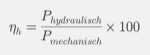
where:
-
Pₕydraulic is the useful hydraulic power,
-
Pₘechanical is the total mechanical power consumed by the pump.

Industrial Pump Group
Contact us
Need help from one of our specialists?
The IPG team of dedicated pump experts is ready to support you.
Call us on business days between 08:00 and 18:00.
Tel: +31(0251) 222 566
Importance of Hydraulic Efficiency
High hydraulic efficiency means that the pump uses input energy effectively to move fluid, resulting in lower energy costs and better overall performance. Key reasons why hydraulic efficiency is important include:
-
Energy savings
Pumps with higher efficiency consume less energy to move the same volume of fluid, leading to significant long-term cost savings. -
Reduced operating costs
By maximizing efficiency, operating costs are reduced because less energy is required to run the pump. -
Environmental performance
Efficient pumps contribute to lower CO₂ emissions due to reduced energy consumption, supporting more sustainable operations. -
Reliability and service life
Pumps that operate more efficiently often have a longer service life and are less prone to wear, as less energy is lost to heat and friction.
Factors That Influence Hydraulic Efficiency
Several factors can affect the hydraulic efficiency of a pump:
-
Impeller design
The shape and design of the impeller have a major impact on efficiency. A well-designed impeller minimizes energy losses due to friction and turbulence. -
Clearances and tolerances
The accuracy of clearances between rotating and stationary pump components is critical. Excessive clearances can cause internal recirculation, reducing efficiency. -
Hydraulic losses
Losses caused by friction, vortices, and flow separation in the pump and piping system reduce hydraulic efficiency. These losses should be minimized through streamlined design and smooth surfaces. -
Operating conditions
Pump efficiency can vary depending on operating conditions such as flow rate, head, and the properties of the pumped fluid. It is important to select pumps that operate efficiently under the specific conditions of the application. -
Maintenance and wear
Regular maintenance and timely replacement of worn components help maintain efficiency. Wear on the impeller or seals can negatively affect pump performance.
Methods to Improve Hydraulic Efficiency
Several strategies can be applied to improve the hydraulic efficiency of pumps:
-
Pump design optimization
Use advanced design tools and simulations to optimize the impeller and other pump components for minimal energy losses. -
High-quality materials
Select high-quality materials that are more resistant to wear and corrosion, extending pump service life and maintaining efficiency. -
Regular maintenance
Implement a proactive maintenance schedule to replace worn components in a timely manner and keep the pump in optimal condition. -
Adaptation to operating conditions
Ensure that the pump operates within the recommended parameters for flow rate and head to maximize efficiency. This may also involve adjusting pump capacity to changing system demands. -
Use of variable frequency drives
Install variable frequency drives to adjust motor speed to actual demand, reducing energy losses and improving overall efficiency.
More articles from the IPG PUMP KNOWLEDGE CENTER:
1. Basic Pump Knowledge
2. Pump Types
2.1 API pumps
2.2 Close-coupled pumps
2.3 Borehole pumps
2.4 Canned motor pumps
2.5 Centrifugal pumps
2.6 Chemical standard pumps
2.7 Submersible pumps
2.8 End-suction pumps
2.9 Hydrofoor units
2.10 In-line pumps
2.11 Immersion pumps
2.12 Lobe pumps
2.13 Multistage pumps
2.14 Diaphragm pumps
2.15 Mixers
2.16 Mixed flow pumps
2.17 Slurry pumps
2.18 Split case pumps
2.19 Thermoplastic pumps
2.20 Total Pump Units
2.21 Vertical turbine pumps
2.22 Water standard pumps
2.23 Progressive cavity pumps
3. Pump Principles and Operation
3.1 Bernoulli’s principle
3.2 Cavitation
3.3 Hydraulic efficiency
3.4 Pump curves
4. Applications and Industries
4.1 Agriculture
4.2 Chemical industry
4.3 Pharmaceutical industry
4.4 Food industry
4.5 Oil and gas industry
4.6 Domestic applications
4.7 HVAC
4.8 Metal industry
4.9 Paper industry
4.10 Power supply
4.11 Water treatment
4.12 Water transport
4.13 Wastewater
4.14 Dredging
4.15 Boiler feed
4.16 Firefighting
4.17 Desalination
4.18 Drainage
4.19 Drinking water
4.20 Cooling water
4.21 Process water